Budgets and Financial Reports
Plan the year month by month, compare the plan with what really happened, and read the statements, ageings and audit records your board and auditor ask for.
1. Budgets in Tocademy
A budget is the school's plan for one financial year: for each income and expense account, and each fund, how much you expect in each of the twelve months. Greenfield's financial year runs September to August, so its 2026 budget runs from September 2026 to August 2027. You keep one budget for the whole school and, if you wish, one for each campus. A budget starts as a draft you can edit freely; once approved it is fixed, and any change becomes a new revision that replaces it only when the revision is approved. Everything here is under Accounting → Budgets and needs the budget permissions in the role editor.
2. Start a draft
On Accounting → Budgets, fill in "A new budget": the "Financial year" (2026), "For" — "The whole school" or one campus — and a "Name" such as "2026/2027 operating budget". Press "Start a draft". The draft opens on its own page.

3. Fill in the twelve-month grid
"The budget, month by month" is a grid: one row per account and fund, one column per month, with the year's total on the right. For each row choose the account (only income and expense accounts are offered) and the fund, then either type each month's figure, or type the year's figure in the small box near the end of the row and press "Spread evenly". Spreading puts the same amount in each month, in whole kobo, with any odd kobo in the last month so the months add up to the year exactly — ₦3,080,000 of depreciation becomes ₦256,666.66 a month with ₦256,666.74 in August. Press "Add a row" for each further line. Spread evenly is a starting point: for boarding feeding, Greenfield moved August's ₦1,200,000 into July because the boarding house is empty in August. Press "Save the draft" whenever you stop; you can come back to it. Under the grid, the totals give the year's income and expenditure apart, and the surplus (or deficit) between them.
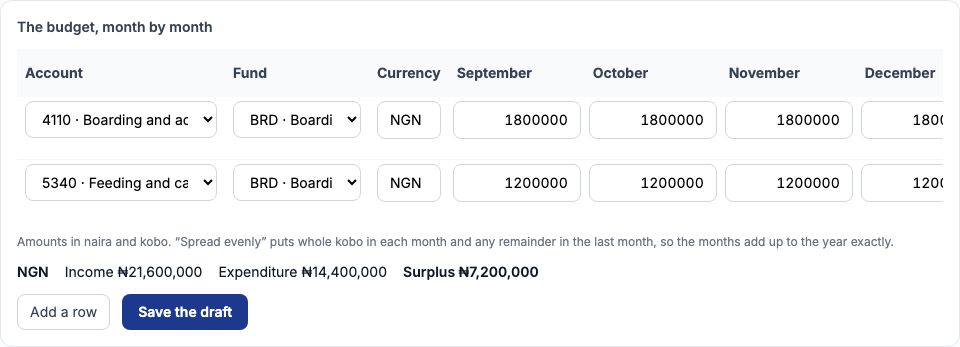
4. Worked example: the operating budget
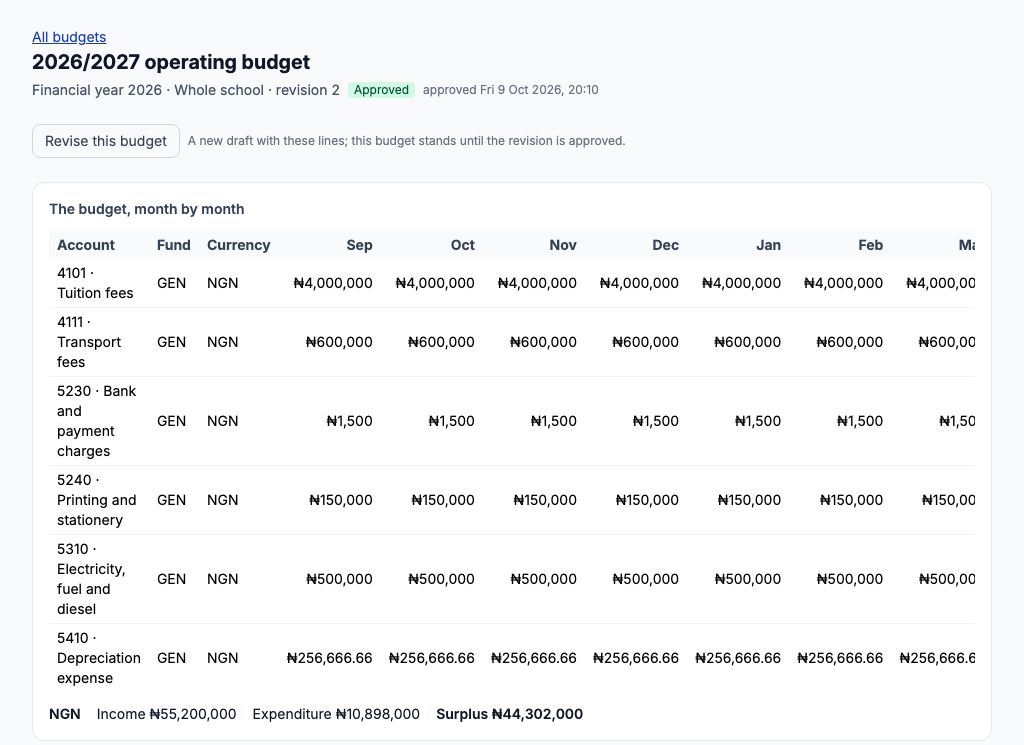
Greenfield's whole-school budget has six lines, all in the GEN · Unrestricted (general) fund, each spread evenly: 4101 Tuition fees ₦48,000,000 (₦4,000,000 a month), 4111 Transport fees ₦7,200,000 (₦600,000), 5230 Bank and payment charges ₦18,000 (₦1,500), 5240 Printing and stationery ₦1,800,000 (₦150,000), 5310 Electricity, fuel and diesel ₦5,400,000 (₦450,000) and 5410 Depreciation expense ₦3,080,000 (₦256,666.66). When the lines are saved and the board has agreed them, press "Approve this budget". Its status changes from Draft to Approved with the date and time.
5. Revising an approved budget
Diesel prices rose in October, so the bursar needed a bigger diesel line. An approved budget cannot be edited — that is deliberate, so nobody can quietly change the plan the board agreed. Instead press "Revise this budget". Tocademy makes a new draft (revision 2) with all the same lines; the approved one stays in force until the revision is approved. In revision 2 the diesel line was spread again at ₦6,000,000 (₦500,000 a month), saved and approved. Revision 1 is then marked Superseded and kept exactly as it was, so you can always show what the original plan said.
6. The list of budgets
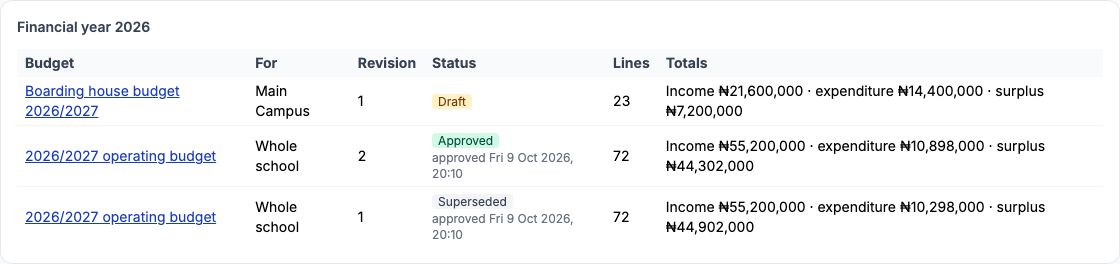
Accounting → Budgets lists each year's budgets with what they are for, the revision number, the status (Draft, Approved or Superseded), the number of lines and its totals — income, expenditure and the surplus or deficit. Type a year in "Financial year (every year when blank)" and press "Show" to see just that year. Click a budget's name to open it.
7. Budget versus actual
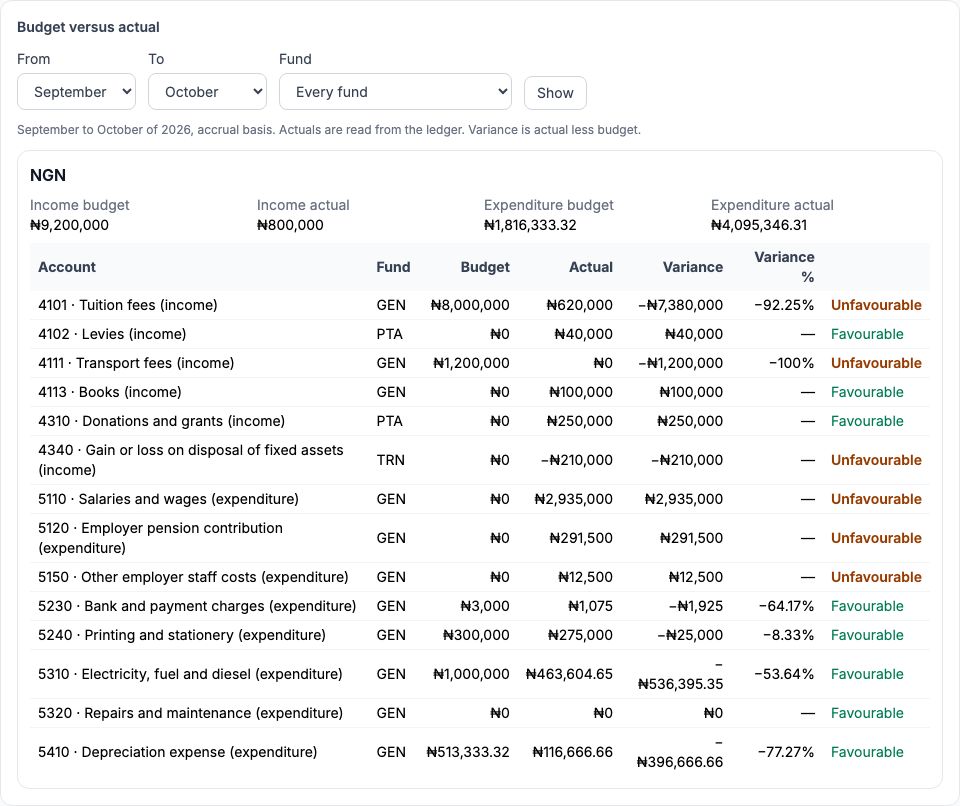
At the bottom of a budget's page, "Budget versus actual" compares the plan with what the books really show. Choose the "From" and "To" months and, if you like, one "Fund" (or "Every fund"), then press "Show". You get income and expenditure totals, then each account's "Budget", "Actual", "Variance" (actual less budget) and "Variance %", marked Favourable or Unfavourable. For September to October: diesel was budgeted at ₦1,000,000 and ₦463,604.65 was spent, a variance of −₦536,395.35 (−53.64%), Favourable because spending less than planned is good. Tuition was budgeted at ₦8,000,000 against ₦620,000 billed so far — Unfavourable, and a prompt to check that the term's bills have been issued. Accounts nobody budgeted for, such as PTA donations, still appear with a budget of ₦0. Greenfield's October payroll appears too (salaries ₦2,935,000 and employer pension ₦291,500), because the run is dated 31 October and the range runs to the end of October; that is why expenditure reads ₦4,095,346.31 against a budget of ₦1,816,333.32, and a reminder to budget for salaries.
8. Financial statements: income and expenditure
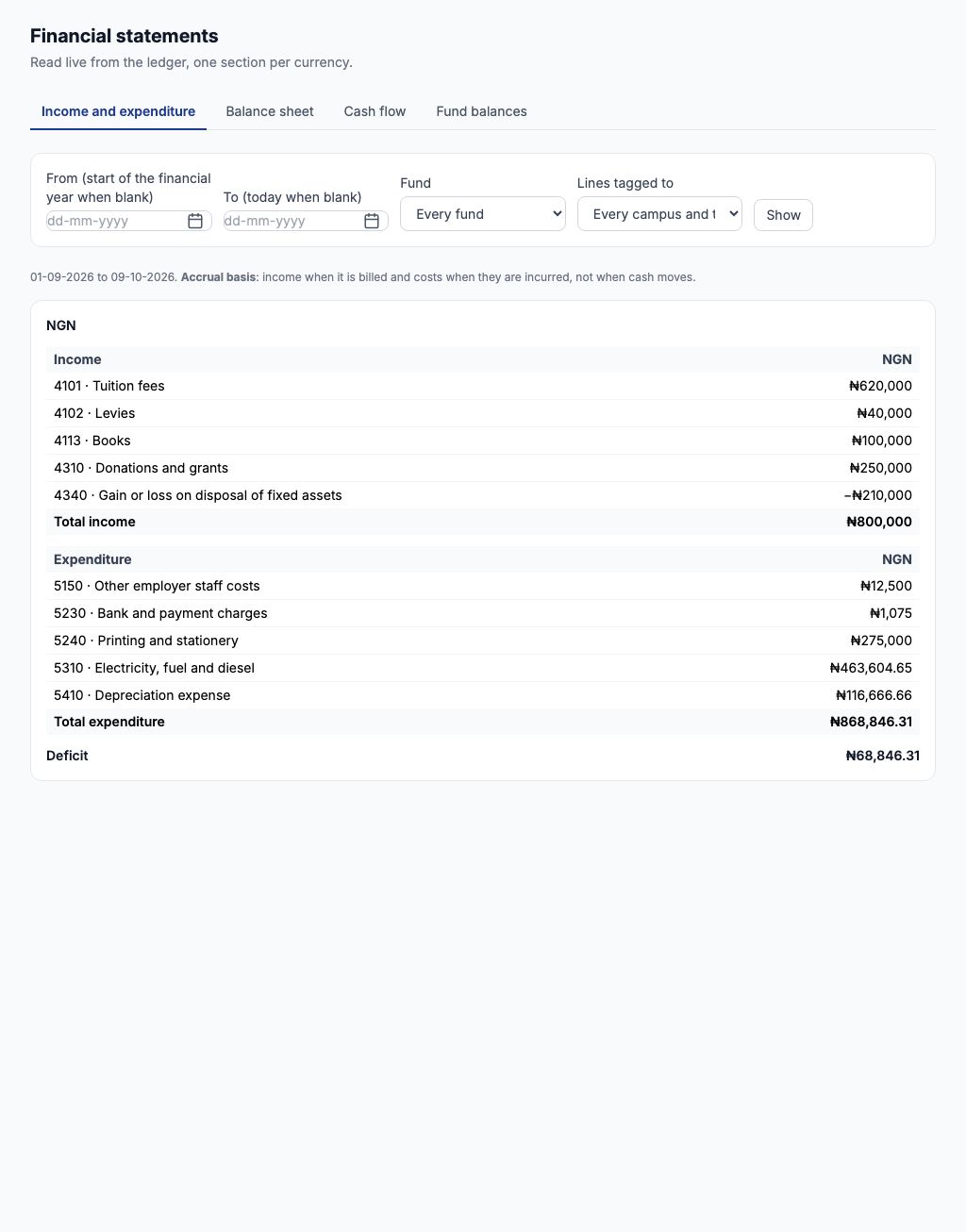
Accounting → Financial statements reads straight from the books, so it is always up to date. It has four tabs. "Income and expenditure" (the school's profit and loss) lists every income account and every expense account for a date range and ends with a Surplus or a Deficit. Leave "From (start of the financial year when blank)" and "To (today when blank)" empty for the year to date, or set them; narrow by "Fund" or by "Lines tagged to" a campus, then press "Show". All statements are on the accrual basis: income counts when it is billed and costs when they are incurred, not when cash moves. In the picture, 1 September to 9 October 2026 shows total income ₦800,000 against expenditure ₦868,846.31 — a deficit of ₦68,846.31, because only part of the term's fees had been billed by then. October's salaries are not in it yet: the payroll run is dated 31 October.
9. The balance sheet
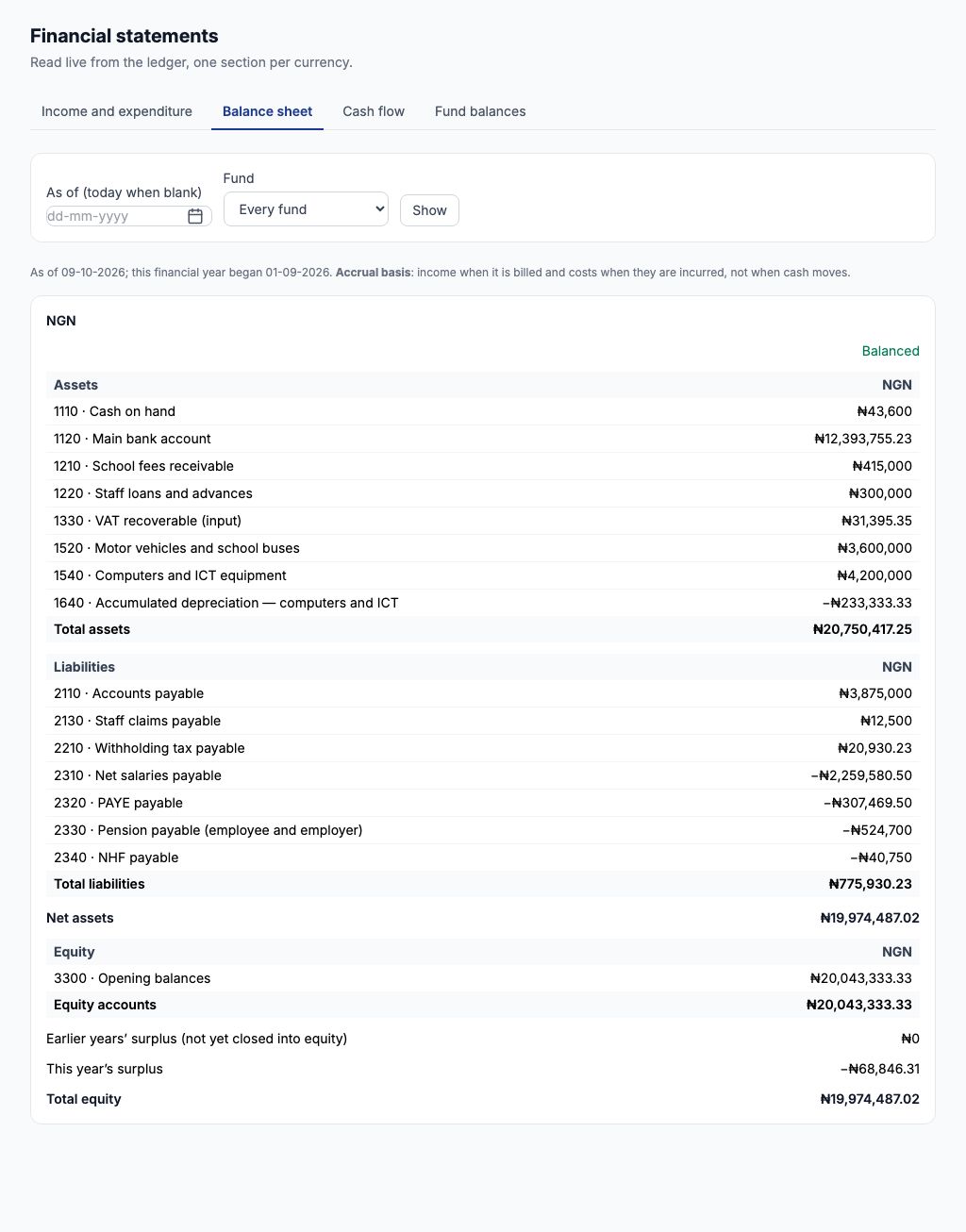
Choose "Balance sheet" to see, on one date, what the school owns (assets), what it owes (liabilities) and the difference (net assets), followed by equity and this year's surplus or deficit. Leave "As of (today when blank)" empty for today. The word "Balanced" in the corner confirms that assets less liabilities equals equity; if it ever says "Does not balance", stop and ask for help before relying on the figures. Accumulated depreciation is shown as a minus against the assets it belongs to, so a ₦4,200,000 laptop purchase with ₦233,333.33 depreciated is carried at the difference. A liability shown as a minus has been paid ahead of the entry that records it: Greenfield paid October's salaries and statutory deductions on 9 October, but the run that records them as owed is dated 31 October, so on 9 October net salaries, PAYE, pension and NHF payable read as minus figures until that date.
10. Cash flow and fund balances
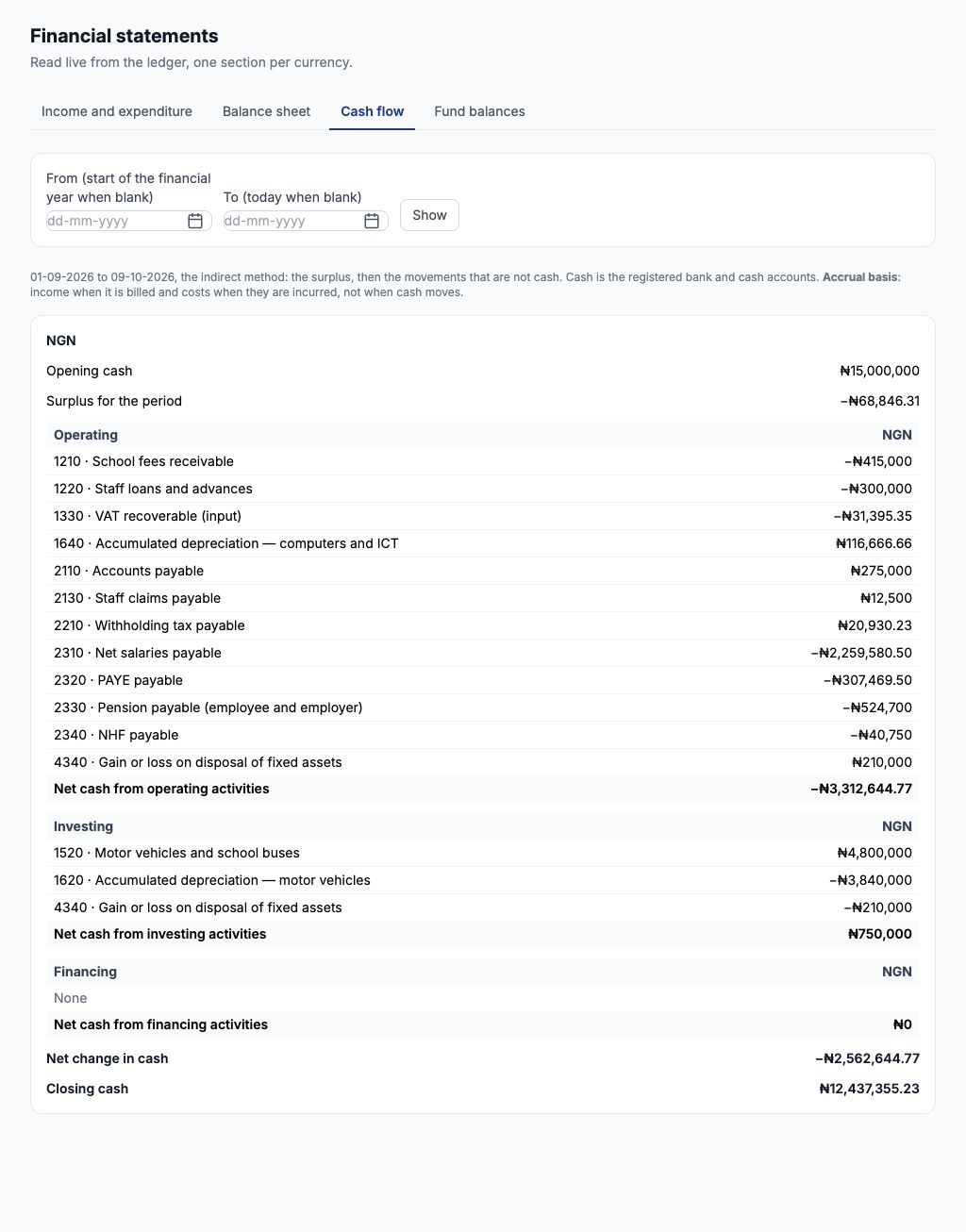
"Cash flow" explains how the cash in the school's bank and cash accounts changed over a range. It starts from "Opening cash", which includes the balances the books opened with (Greenfield's ₦15,000,000 at Zenith), then the surplus, adds back the movements that are not cash (depreciation, money owed to suppliers, fees not yet collected), and then shows investing and financing, ending with "Closing cash". An asset bought on credit, such as the school bus, moves no cash and is left out; money from selling an asset is an investing inflow, so the ₦750,000 for the old Hiace makes "Net cash from investing activities" ₦750,000. If the computed change does not agree with the bank and cash accounts, a note says so. "Fund balances" shows each fund's opening balance, income, expenditure, transfers and closing balance, with restricted money (PTA, grants) kept apart from unrestricted money — the statement to show a PTA or a donor what their money did.
11. Fund balances in the example
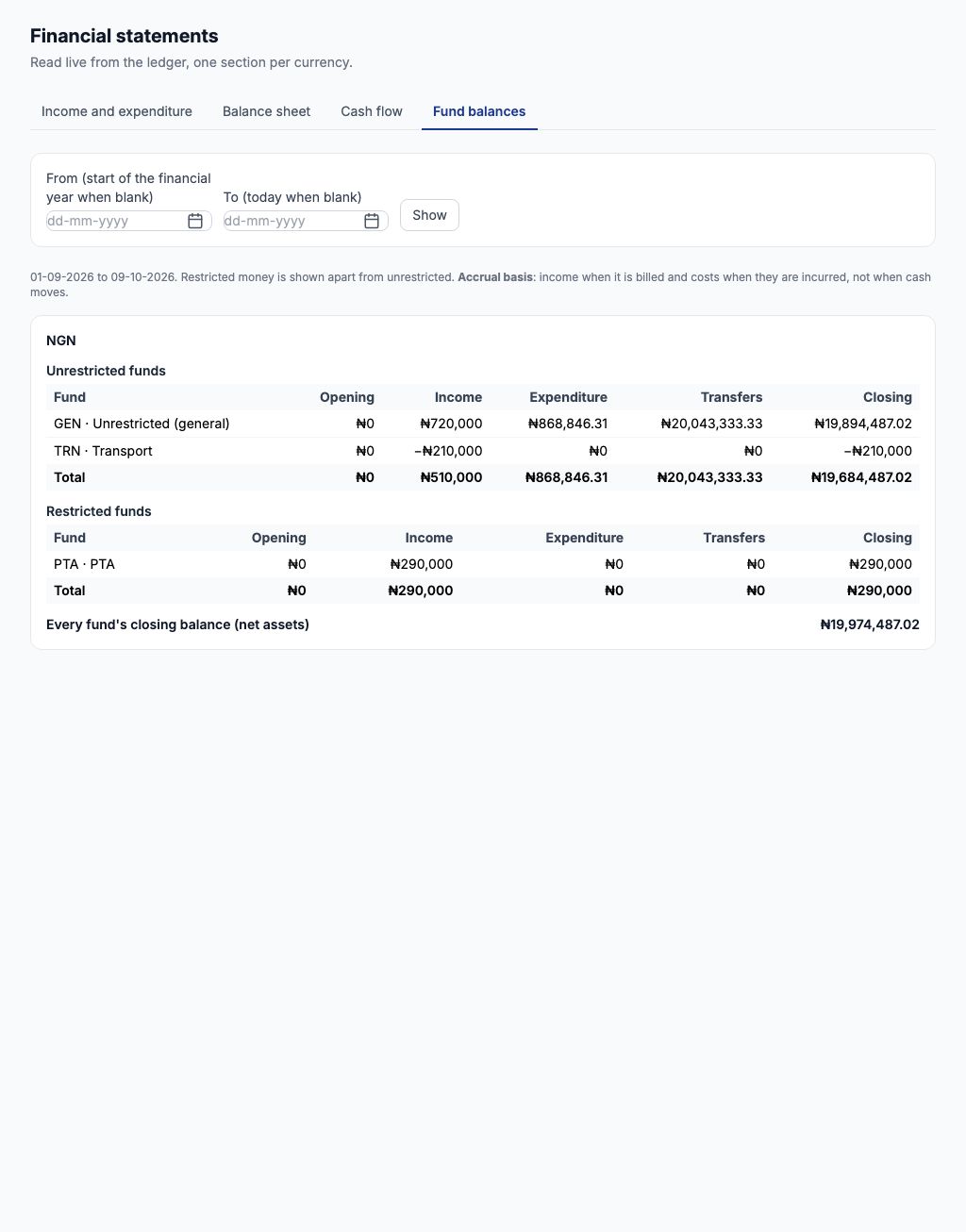
Greenfield's "Fund balances" tab shows the PTA fund (restricted) holding ₦290,000 — the ₦250,000 borehole contribution and ₦40,000 of levies — apart from the general fund. Restricted money should only ever be spent on its purpose, and this table is how you prove it.
12. Who owes the school: fee debtors ageing
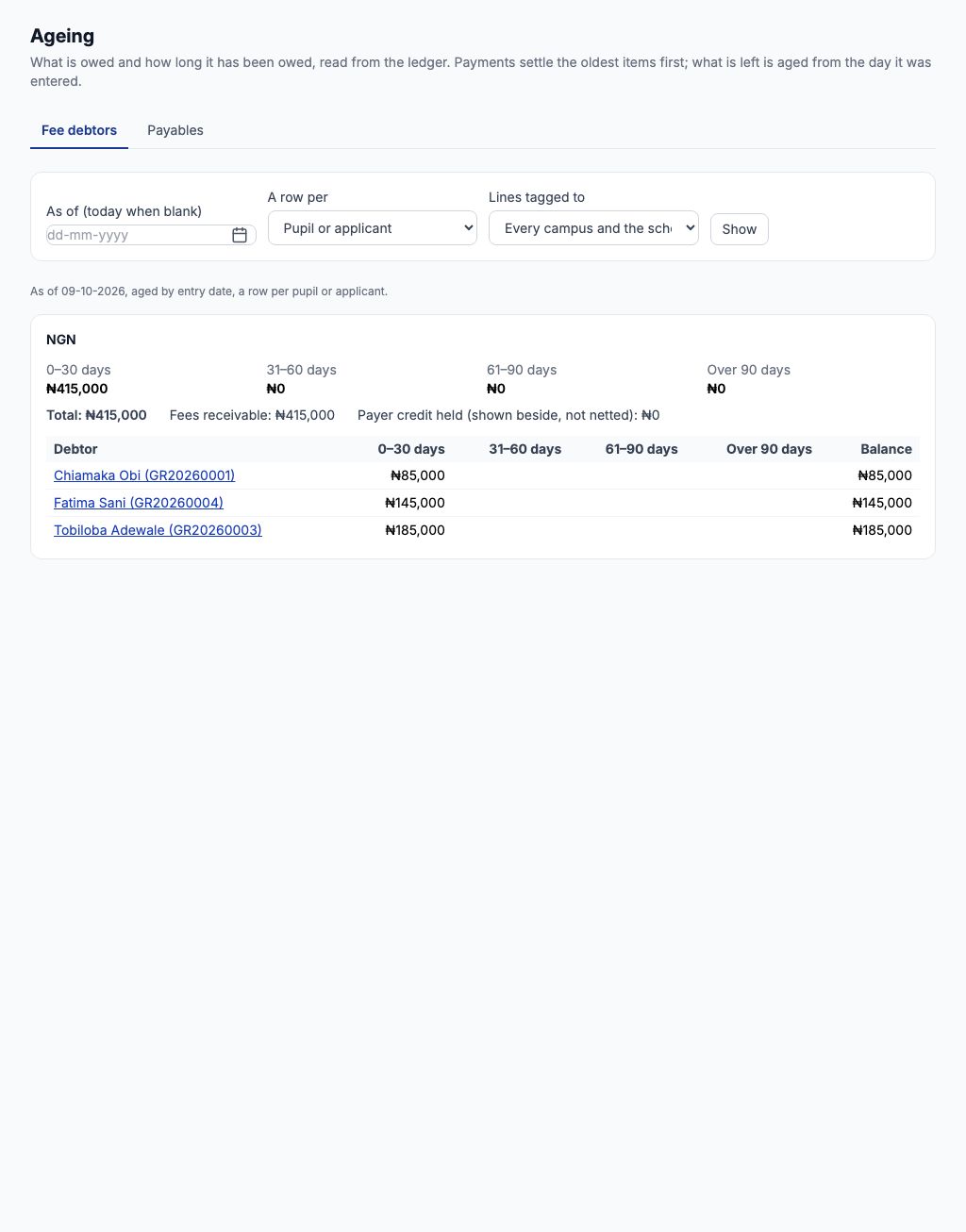
Accounting → Ageing answers "how much is owed, and how long has it been owed?" On "Fee debtors", each pupil's unpaid balance is split into "0–30 days", "31–60 days", "61–90 days" and "Over 90 days" by the date each charge was entered, with payments settling the oldest charges first. Choose "Pupil or applicant" or "Family" in "A row per" to see one row per child or one per family. The total is checked against the "Fees receivable" account; if they ever differ, a warning says so. Click a name to open that child's statement. In the example three pupils owe ₦415,000 between them, all under 30 days.
13. Who the school owes: payables ageing
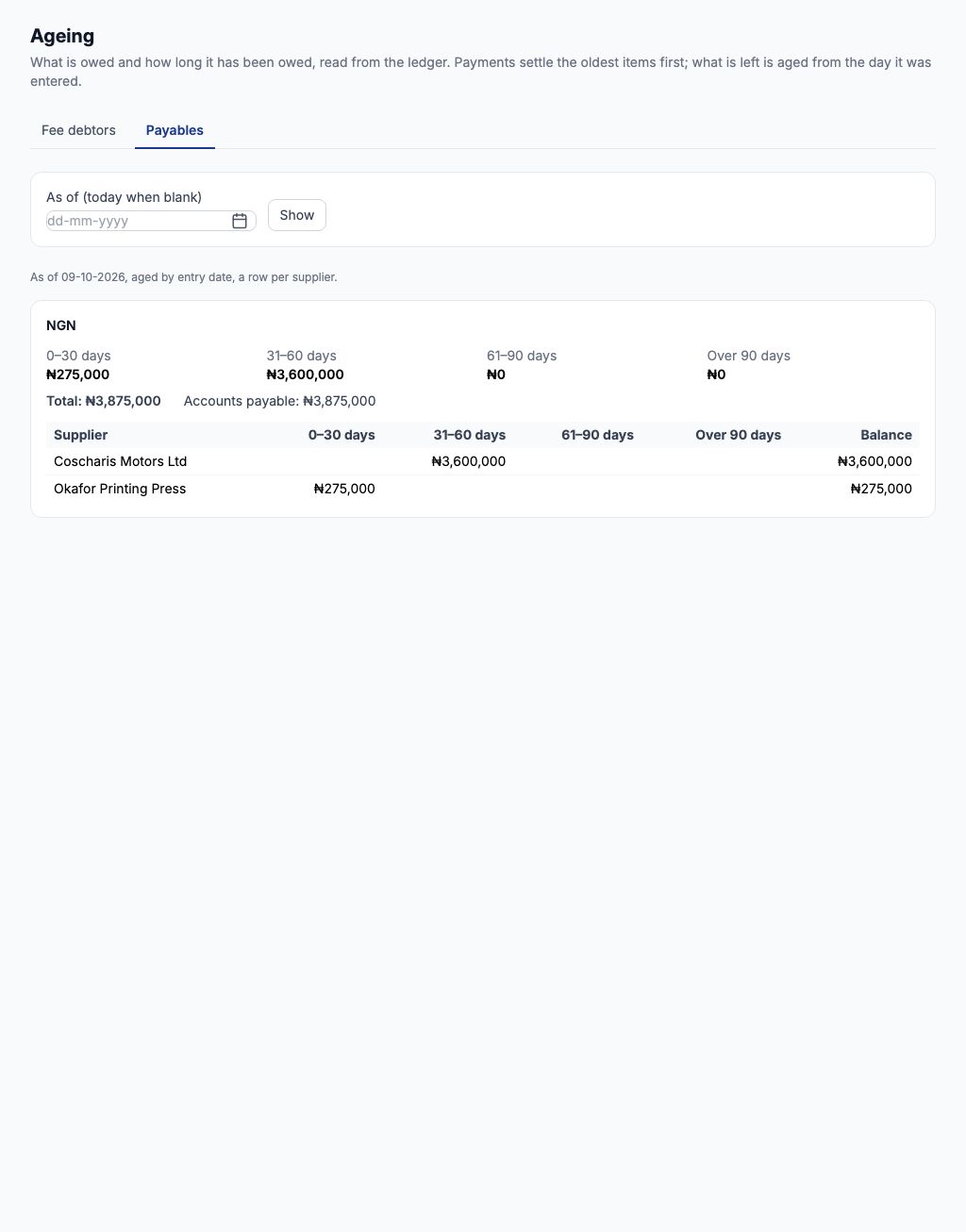
The "Payables" tab does the same for suppliers: one row per supplier, aged from the day each bill entered the books (the day an expense was approved, or an asset bought on credit was activated). The total is checked against "Accounts payable". In the example the school owes ₦3,875,000: ₦3,600,000 to Coscharis Motors Ltd for the school bus, now 31–60 days old, and ₦275,000 to Okafor Printing Press for exam booklets, under 30 days. Use this list each month to decide who to pay next and to avoid suppliers chasing you.
14. The auditor's export
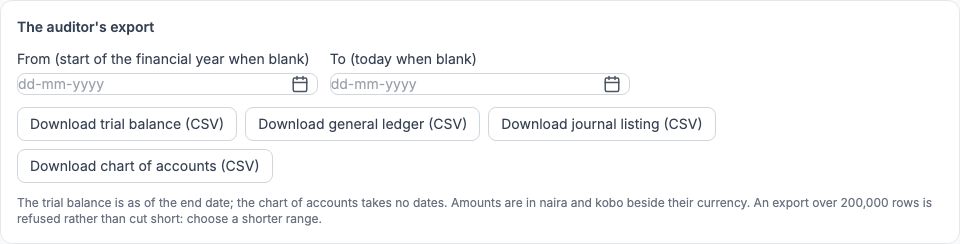
Accounting → Auditor & audit trail is where you prepare for the external auditor. Under "The auditor's export", set the range in "From (start of the financial year when blank)" and "To (today when blank)", then use one of the four download buttons — "Trial balance", "General ledger", "Journal listing" and "Chart of accounts", each saved as a CSV file that opens in Excel. The trial balance is as of the end date; the chart of accounts takes no dates. Amounts are written in naira and kobo beside their currency. A very large export (over 200,000 rows) is refused rather than cut short, so choose a shorter range.
15. The audit trail
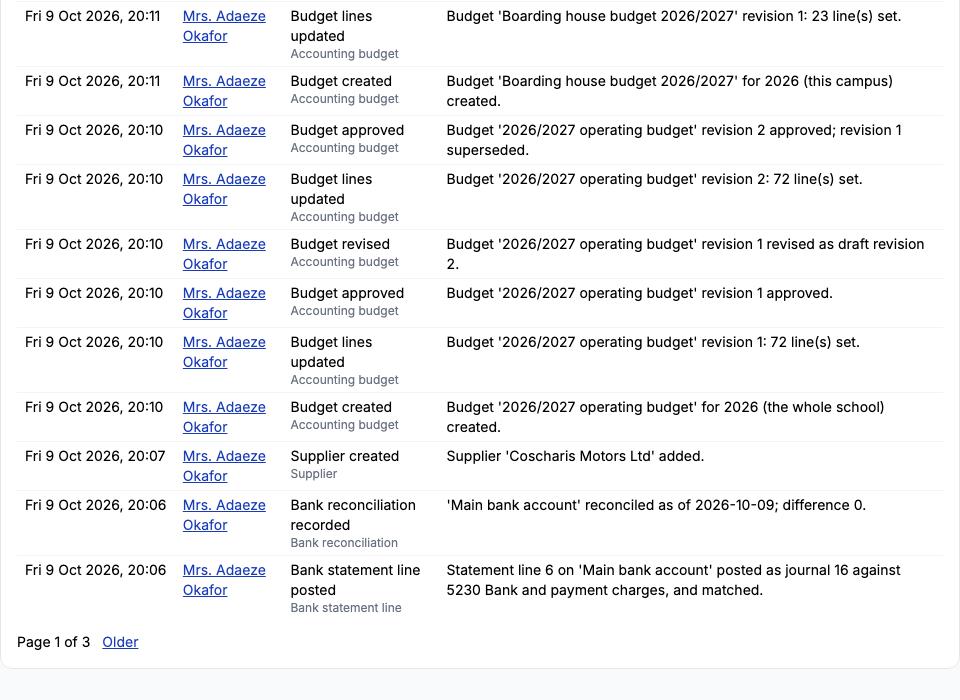
"The audit trail" lists everything done to the books, newest first: when, who, what and the details — each budget created, approved or revised, each statement imported, each line matched or excluded with its reason, each journal posted. Set "From" and "To" and press "Show" to look at a period, and click a person's name to see only what they did. Nothing in this list can be edited or removed, which is what makes it worth showing an auditor.
Still stuck?
Email info@tocel.ng and tell us which guide you were following.