Payroll in the Books
How a finalised payroll run and its payments post to the ledger, how to see what is still owed to the tax and pension authorities, how to record and void statutory remittances, and where payroll and staff claims are mapped to accounts.
1. Payroll posts itself
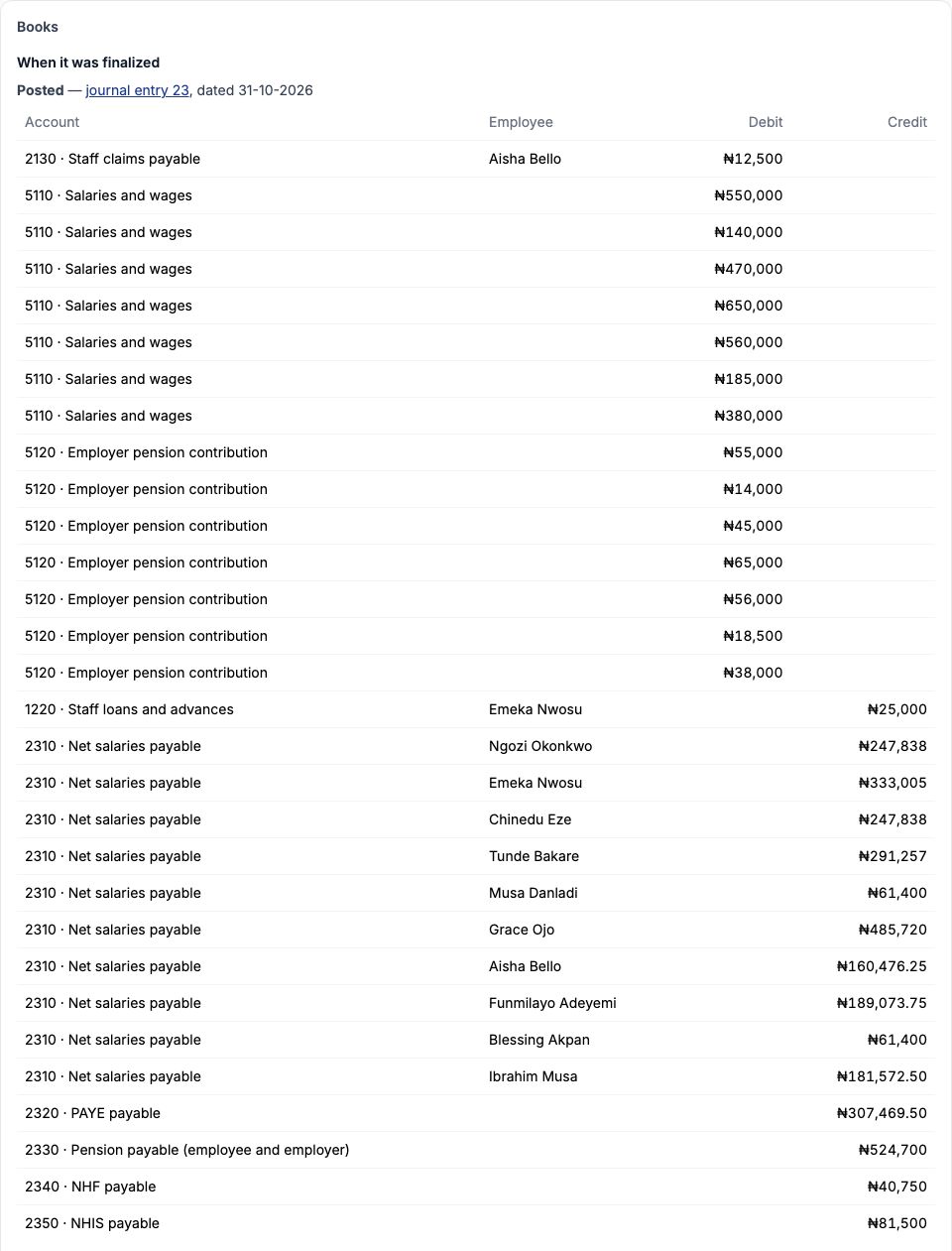
When the school's books are set up (see the Accounting Setup guide), you never type a payroll journal. Finalising a payroll run posts one entry for the whole run, and each batch of payments recorded on the run posts another. Both appear in the "Books" panel at the foot of the run page in HR (HR → "Payroll" → the run), each linked to its journal entry. Greenfield finalised its October 2026 run on 9 October; the panel shows "When it was finalized" — Posted, journal entry 23, dated 31-10-2026 (the last day of the pay period) — with every line beneath.
2. Reading the finalisation entry
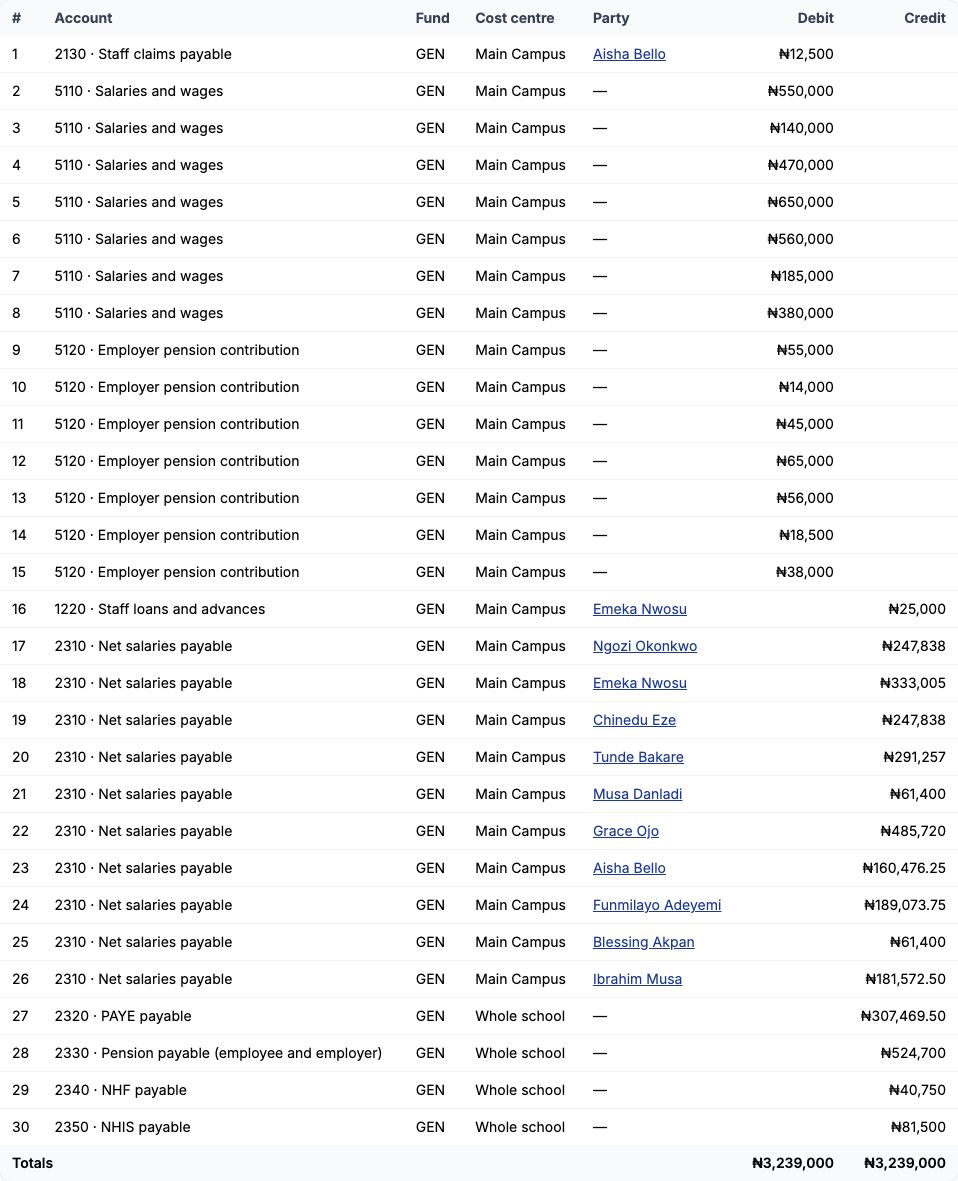
Entry 23 balances at ₦3,239,000. Debits: the gross pay of ₦2,935,000 to 5110 Salaries and wages (on several lines, one for each group of staff), the school's own 10% pension of ₦291,500 to 5120 Employer pension contribution, and ₦12,500 to 2130 Staff claims payable for Aisha Bello, clearing the expense claim the run reimbursed. Credits: ₦25,000 to 1220 Staff loans and advances for Emeka Nwosu's first loan repayment; the net pay owed to each employee on 2310 Net salaries payable, one line per person with their name (₦247,838 for Chinedu Eze, ₦2,259,580.50 in all); and the statutory amounts now owed — ₦307,469.50 to 2320 PAYE payable, ₦524,700 to 2330 Pension payable (the employees' 8% of ₦233,200 plus the school's ₦291,500), ₦40,750 to 2340 NHF payable and ₦81,500 to 2350 NHIS payable. Choose the entry's number to open it in "Journals".
3. The payment entry
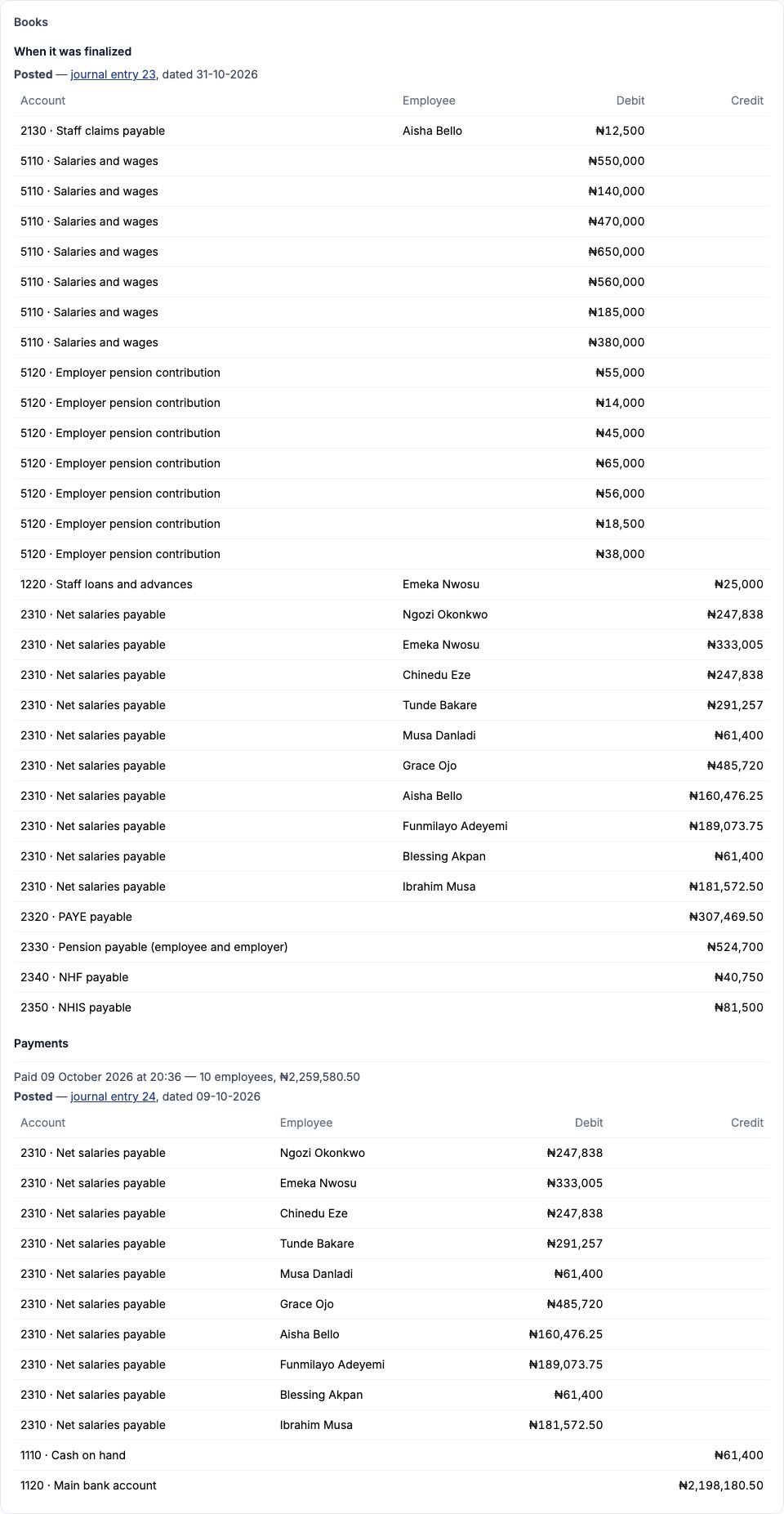
When the run's payments were recorded as paid, the "Payments" part of the panel gained a line — paid 09 October 2026, 10 employees, ₦2,259,580.50 — and journal entry 24. It debits 2310 Net salaries payable for each employee, emptying what the finalisation entry put there, and credits the money that left the school: ₦2,198,180.50 from 1120 Main bank account for the nine paid by bank transfer and ₦61,400 from 1110 Cash on hand for Blessing Akpan, paid in cash. If you record payments in several batches, each batch posts its own entry. If the panel ever says a payment's entry differs from what was paid, look at the posting sources page before the month is closed.
4. Accounting → Payroll in the books
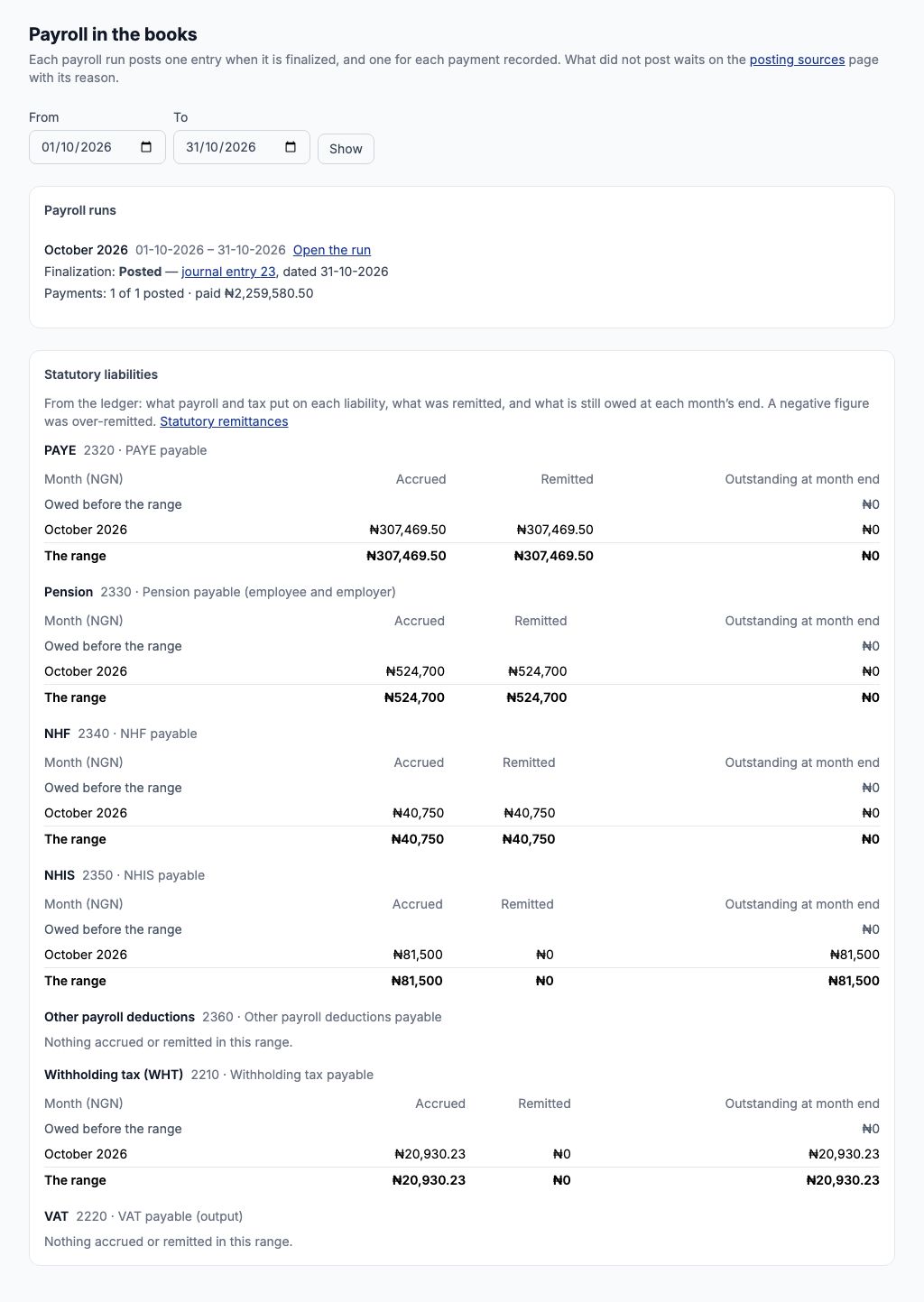
Choose "Payroll in the books" in the Accounting menu to see payroll from the bursary's side. "Payroll runs" lists every run whose pay period falls in the dates chosen, with its finalisation entry and how many payment batches have posted. "Statutory liabilities" shows, for PAYE, pension, NHF, NHIS, other payroll deductions, withholding tax and VAT, what was accrued and remitted each month and what was still owed at the month's end. Set "From" and "To" and press "Show". A run's entry is dated the last day of its pay period, so October's amounts are dated 31-10-2026; with "To" left blank the liabilities run to the end of the latest month anything has posted in, so October's PAYE shows even before the month ends. A "To" you type is kept as typed.
5. Runs finalised before the books were set up
A run that was finalised before the school turned on its books — or whose posting failed, for example because an account was deactivated — shows as waiting or not posted in the "Books" panel and on "Payroll in the books". Someone with permission to post payroll then sees "Post the run to the books now" (and "Post its payments now" for its payments) on "Payroll in the books", or "Post to the books now" in the run's Books panel. Pressing it posts the same entries finalising would have. A run that has already posted is never posted twice: Tocademy refuses and names the entry it already made.
6. Example: remitting October's PAYE
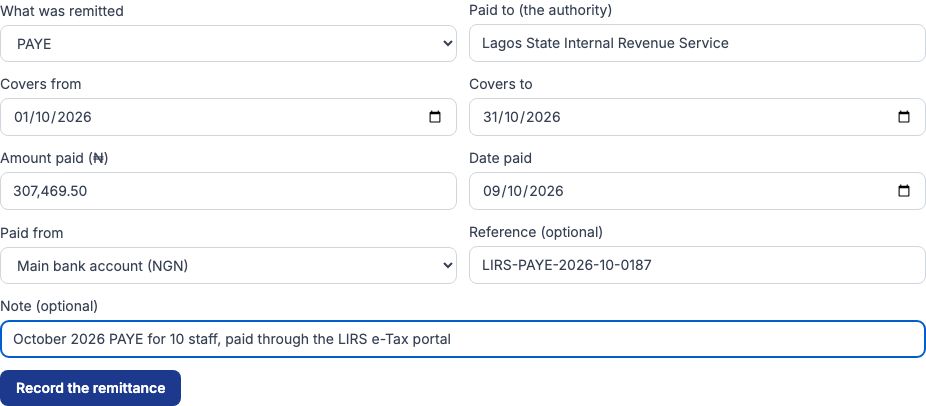
Tocademy records a remittance after the money has gone; it does not pay the authority. Greenfield paid October's PAYE to the Lagos State Internal Revenue Service through the LIRS e-Tax portal, then chose "Statutory remittances" in the Accounting menu and filled in "Record a remittance": in "What was remitted" choose "PAYE"; "Paid to (the authority)" Lagos State Internal Revenue Service; "Covers from" 01/10/2026 and "Covers to" 31/10/2026; "Amount paid (₦)" 307,469.50; "Date paid" 09/10/2026 (it cannot be a future date); "Paid from" the Main bank account; and the LIRS receipt number as the reference. Press "Record the remittance". It posts at once: debit 2320 PAYE payable, credit 1120 Main bank account.
7. Pension and NHF
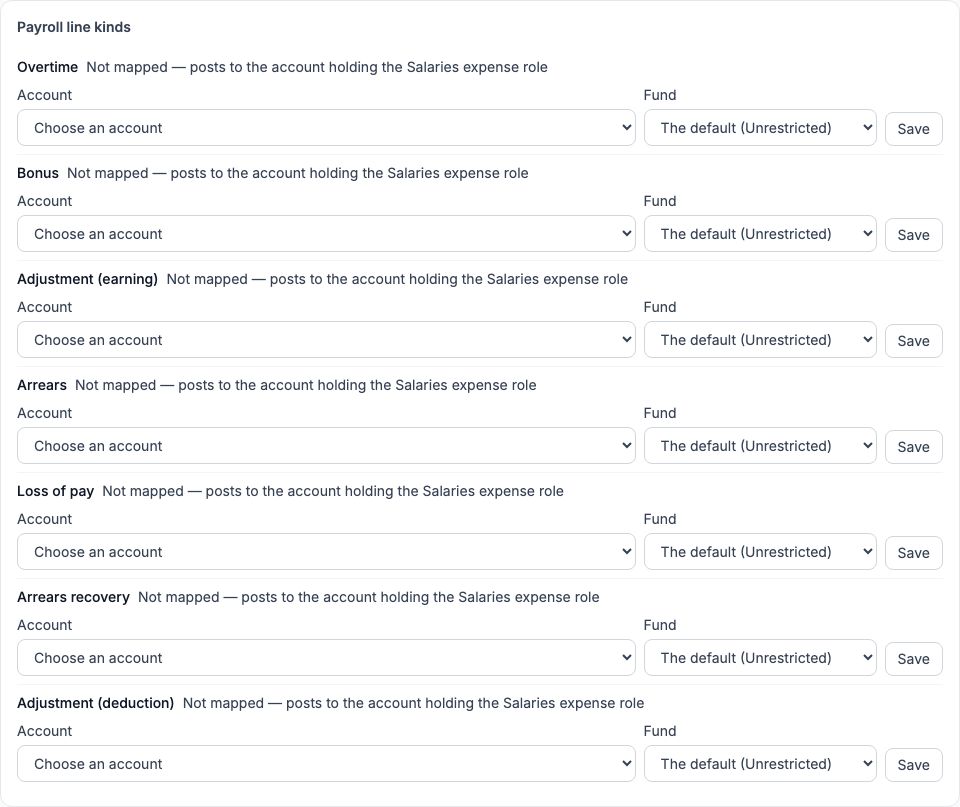
Pension is remitted as one amount covering both the employees' 8% and the school's 10%. Greenfield paid ₦524,700 to its staff's Pension Fund Administrators (ARM, Stanbic IBTC and others) according to the PenCom schedule and recorded it as "Pension" with the schedule's reference. NHF goes to the Federal Mortgage Bank of Nigeria; ₦40,750 was owed. A remittance is never edited — if one is wrong, void it and record it again. The amount is not capped at what is owed: if you remit more than the books say is due, "Statutory liabilities" shows the extra as a negative figure.
8. Voiding a remittance
The bursar typed the NHF remittance as ₦40,570 instead of ₦40,750. To correct it, find the row under "Remittances", type the reason in "Why void it" and press "Void". The row is marked Voided with the reason, a reversal entry is posted (journal entry 28 at Greenfield, mirroring entry 27), and the voided remittance no longer counts as remitted. A voided remittance is never restored. Greenfield then recorded the right amount, ₦40,750, with its own reference. The voided row then links to both entries: the original (27) and its reversal (28).

9. What is still owed
"Remittances" lists every remittance in the financial year, newest first, with what it covered, when and from which account it was paid, its reference and its journal entry; filter by "Liability" and dates and press "Show". Back on "Payroll in the books", October now reads ₦0 outstanding for PAYE, pension and NHF, while NHIS shows ₦81,500 accrued, nothing remitted and ₦81,500 outstanding at month end. That is the list for the bursar's next trip to the bank, and the figure an auditor will ask about.
10. Payroll mappings: pay components
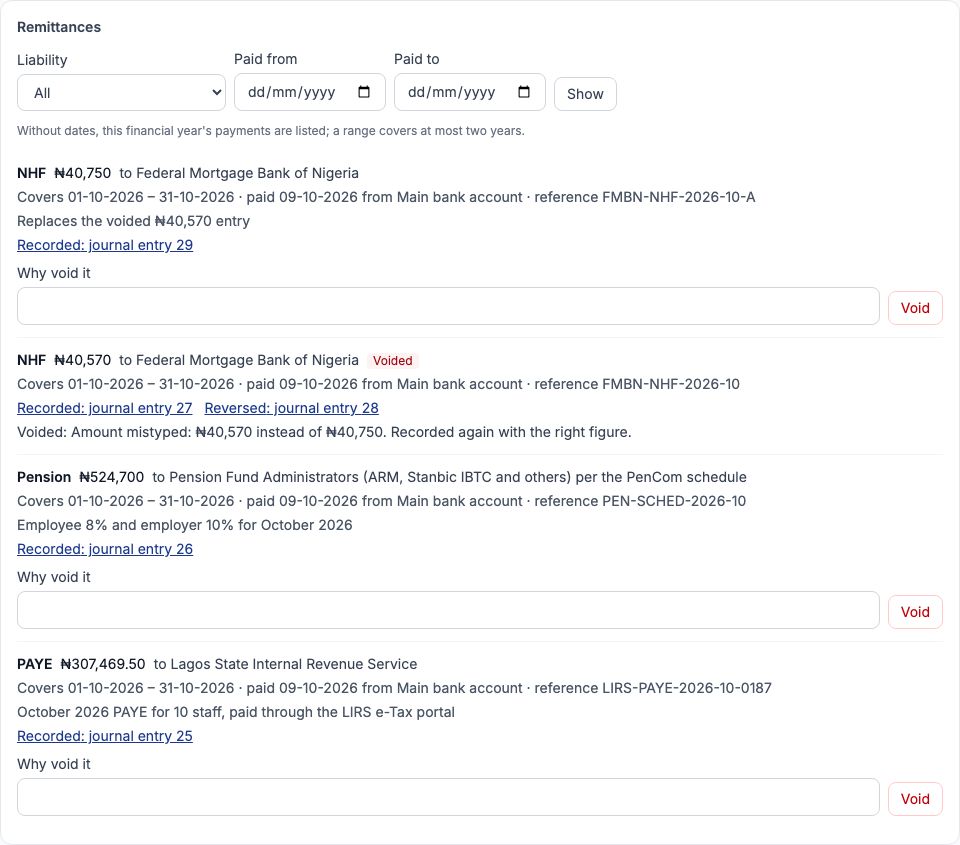
Where each part of payroll posts is set under Accounting → "Posting mappings" (also reached from "Accounting settings"). Unlike fees, payroll always posts: a pay component, line kind or payment method that is not mapped posts to the account holding its fallback role, which is why Greenfield's run posted without any mapping. Under "Pay components", Basic salary, Housing allowance and Transport allowance all fall back to the Salaries expense role (5110 Salaries and wages). To post, say, housing to its own expense account, choose it in "Account" (and a "Fund" if it is paid from a restricted fund) and press "Save". A mapping affects entries posted from then on, not ones already posted.
11. Line kinds and payment methods
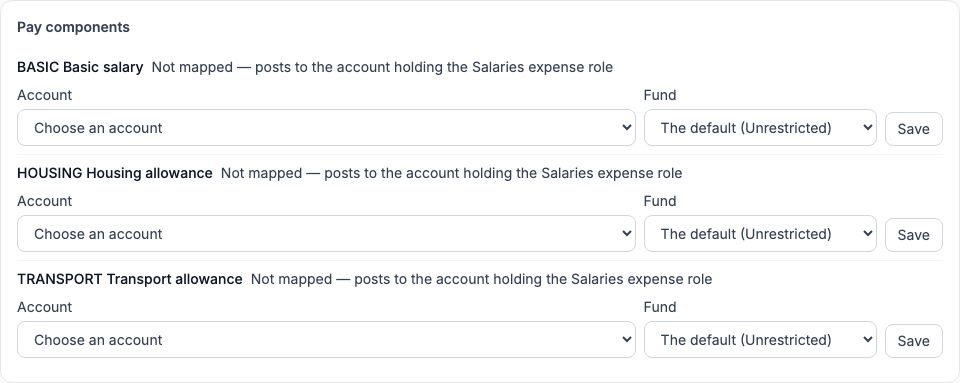
"Payroll line kinds" covers the other kinds of pay a run can contain — overtime, bonuses, adjustments, arrears, loss of pay and arrears recovery — each falling back to Salaries expense until mapped. Emeka Nwosu's ₦20,000 allowance in October was an adjustment earning, so it went to 5110 with his salary. "Payroll payment methods" decides which bank or cash account a payment comes out of: bank transfer and cheque fall back to the Bank role (1120 Main bank account) and cash to the Cash role (1110 Cash on hand). A school with a separate salary account maps bank transfer to it.
12. Staff claims must be mapped
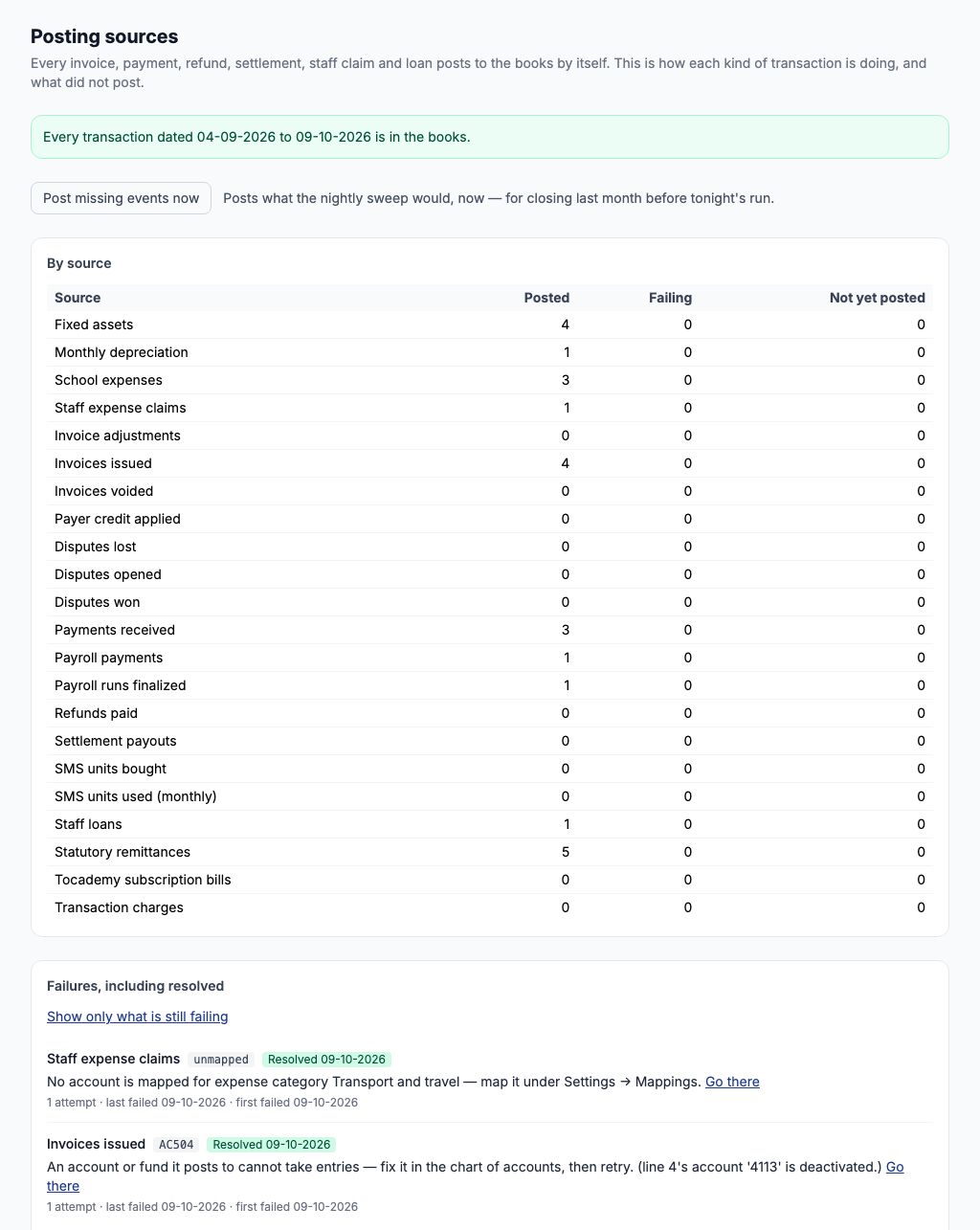
Staff expense claims are different: an approved claim posts its own entry (debit the expense, credit 2130 Staff claims payable to the employee), and a claim category that is not mapped does not post at all. Greenfield created its claim categories after setting up the books, so when Aisha Bello's ₦12,500 Transport and travel claim was approved, Accounting → "Posting sources" showed one staff expense claim failing: no account was mapped for the category. Until it is fixed, the month cannot be closed — and the payroll entry's ₦12,500 debit to 2130 has nothing to clear. The picture shows the page after the fix below, with "Show resolved failures too" chosen: the failure stays listed, marked resolved, with its reason.
13. Map the category and retry
On "Posting mappings", under "Staff expense categories", Greenfield mapped Transport and travel to 5150 Other employer staff costs, Classroom supplies to 5330 Teaching and learning materials and Meals on school trips to 5340 Feeding and catering, pressing "Save" for each. Back on "Posting sources", press "Retry" on the failure (or "Post missing events now", which also runs every night by itself). The page then said the entry was posted and every transaction was in the books. Map each new claim category as soon as you create it.

14. The claim's own entry
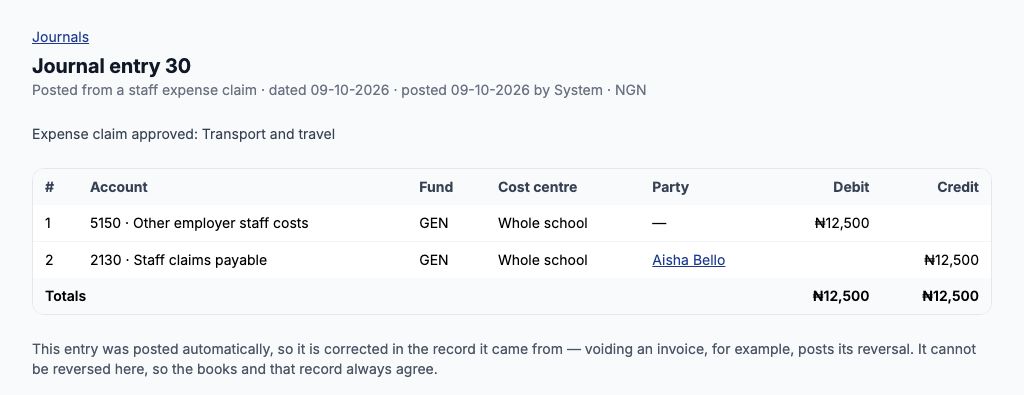
Journal entry 30 is the claim: debit 5150 Other employer staff costs ₦12,500, credit 2130 Staff claims payable ₦12,500, with Aisha Bello as the party. The payroll run's debit of ₦12,500 to 2130 for Aisha then clears it, and her ₦12,500 left the bank inside the net pay paid by entry 24. Staff loans post the same way: recording a loan's payout posts it as owed to the school on 1220 Staff loans and advances, and each payroll run's repayment (₦25,000 for Emeka in October) reduces it. Together, the payroll guides and this one leave every naira of October's payroll traceable from the payslip to the bank.
Still stuck?
Email info@tocel.ng and tell us which guide you were following.