Fee Receivables and Family Statements
How fee bills and payments reach the books, what each pupil and family owes according to the ledger, and the check that keeps the two in step.
1. What receivables means
Fees receivable is the money pupils and applicants owe the school for bills already raised. In the books it is one account, 1210 School fees receivable, with one total for the whole school. Behind that account, every line also names the pupil or applicant it belongs to, so the same lines can be added up child by child. Accounting → Receivables shows both views side by side. The total tells the proprietor how much is outstanding. The child-by-child list tells the bursar who owes it. A check confirms the two agree.
2. You do not post fees by hand
Nothing on these pages is typed in. Bills and payments are handled in Finance exactly as before: fee structures under Finance → Set up, bills raised with "Run billing" on Generate invoices, and money received recorded on the bill with "Record a counter payment" or paid online. Each of these posts its own entry to the books the moment it happens. Voiding a bill, an adjustment or concession on a bill, payer credit being used, a refund being paid and a payment dispute post too. If something cannot post, it waits on Accounting → Posting sources until it is fixed; see the Journals, the Ledger and Posting guide.
3. Example: Chiamaka's ₦185,000 first-term bill
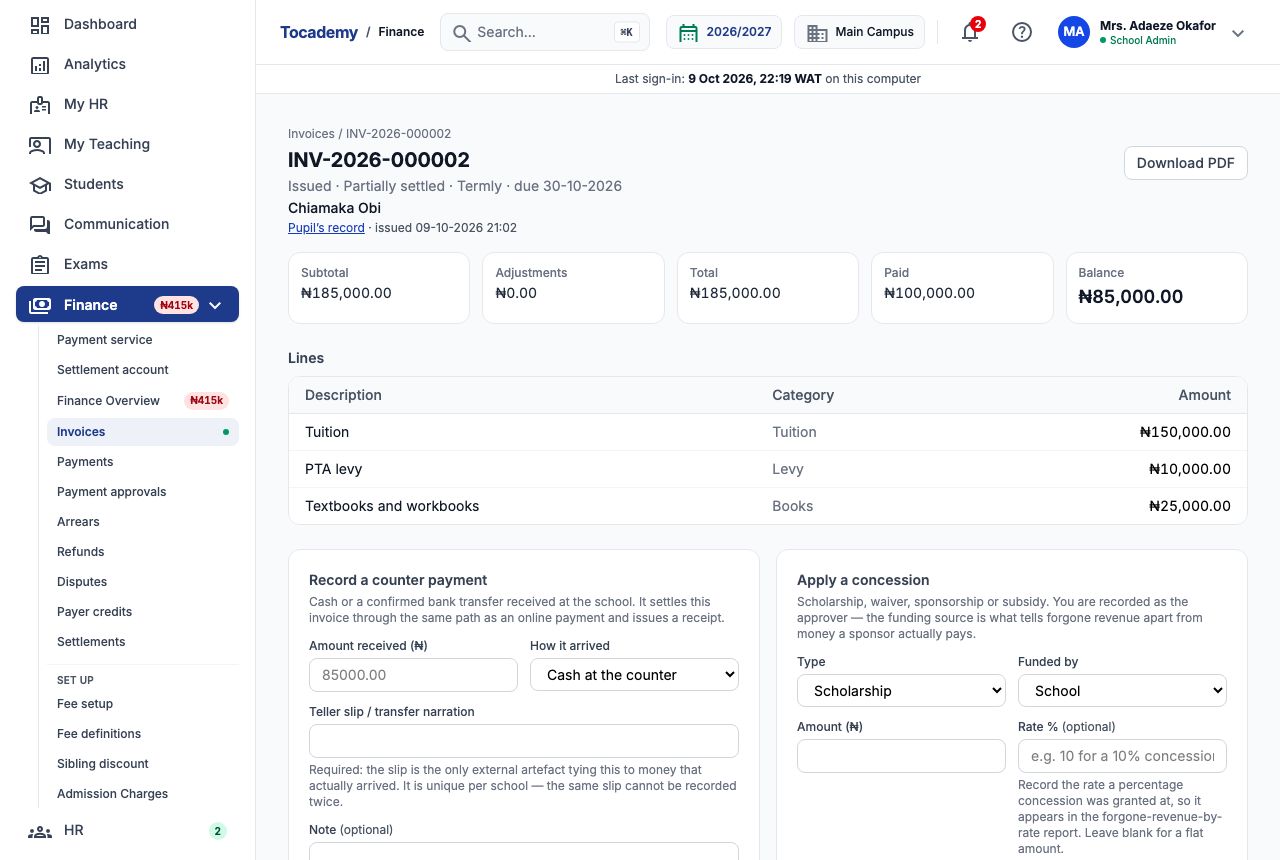
Chiamaka Obi is in JSS1 A at Greenfield Model College, and her father, Mr. Ifeanyi Obi, is her guardian. Her first-term bill, INV-2026-000002, came from the JSS1 fee structure: Tuition ₦150,000, PTA levy ₦10,000, and Textbooks and workbooks ₦25,000, a total of ₦185,000, due 30-10-2026. In this picture Mr. Obi has already paid ₦100,000, so Finance marks the bill "Partially settled" and shows a balance of ₦85,000. The next sections follow both of those events into the books.
4. The entry her bill made
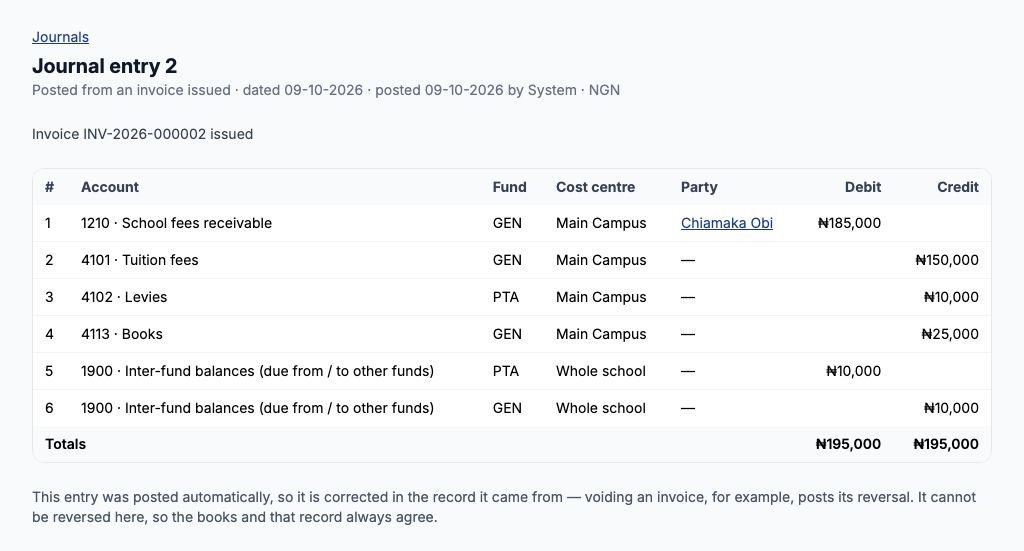
When the bill was issued, journal entry 2 posted by itself ("Posted from an invoice issued", by System). Line 1 debits 1210 School fees receivable ₦185,000 and names Chiamaka Obi. That is the books saying she now owes ₦185,000. The next three lines credit income, each to the account its fee category is mapped to. ₦150,000 goes to 4101 Tuition fees, ₦10,000 to 4102 Levies and ₦25,000 to 4113 Books. Each line carries a fund. Greenfield maps the levy to the PTA fund (see Setting Up the Books), so the levy line is in PTA and the rest are in GEN, the general fund. The cost centre is Main Campus, Chiamaka's campus.
5. Why the entry totals ₦195,000, not ₦185,000
Lines 5 and 6 are a matching pair on 1900 Inter-fund balances: ₦10,000 debit in PTA and ₦10,000 credit in GEN. The whole ₦185,000 Chiamaka owes sits in the general fund's receivable, but ₦10,000 of the income belongs to the PTA. The pair records that the general fund holds ₦10,000 on the PTA's behalf, so the PTA fund balances on its own and the general fund does too. It adds ₦10,000 to both columns, which is why the entry's totals read ₦195,000. Chiamaka's bill is still ₦185,000. A school that leaves every fee in the general fund will not see these lines.
6. The entry her father's payment made
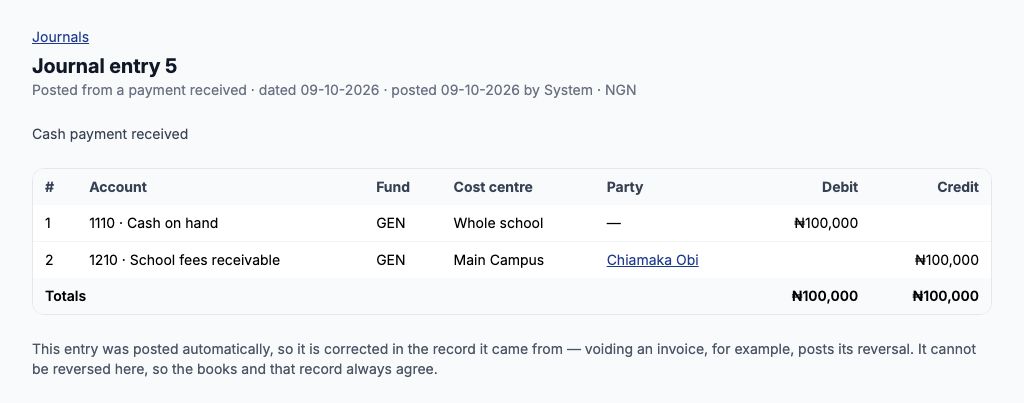
Mr. Obi paid ₦100,000 in cash at the bursary, and the bursar recorded it on the bill with "Record a counter payment": "Amount received (₦)" 100000, "How it arrived" "Cash at the counter", teller slip TELLER-0412. The moment she pressed "Record payment", journal entry 5 posted: debit 1110 Cash on hand ₦100,000 (the till holds ₦100,000 more), credit 1210 School fees receivable ₦100,000 for Chiamaka Obi (she owes ₦100,000 less). Her balance in the books is now ₦185,000 − ₦100,000 = ₦85,000, the same as Finance shows. Choosing "Bank transfer (confirmed)" instead debits 1120 Main bank account. That is how her brother Kelechi's ₦195,000 transfer posted, as entry 6.
7. The receivables page and its reconciliation
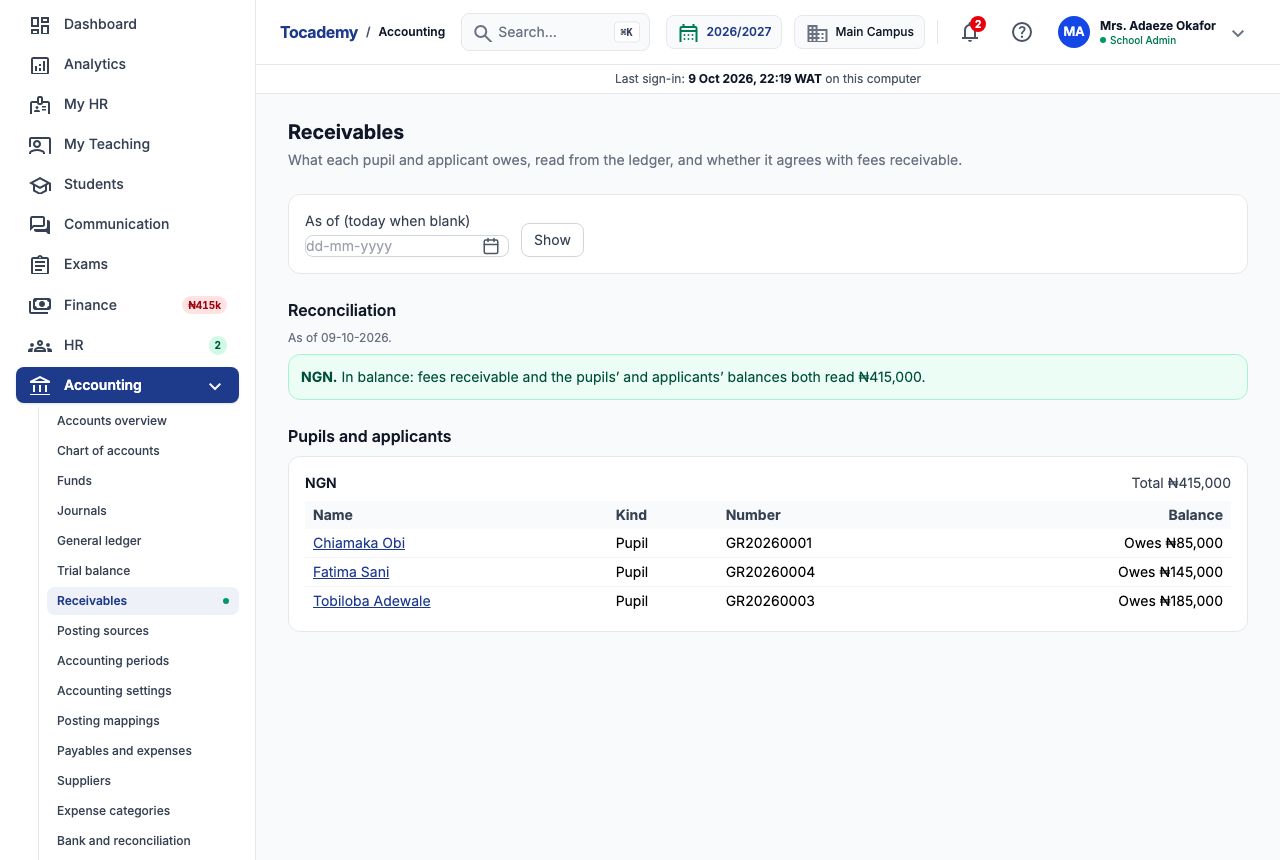
Accounting → Receivables opens with "Reconciliation". For each currency it compares two figures: the balance of fees receivable, and the total of every pupil's and applicant's own balance. When they agree it shows a green line saying they are in balance and the amount both read. Greenfield's reads ₦415,000. When they differ it turns amber and says how far out they are. A period cannot close while they differ. The usual cause is a journal to fees receivable that names no pupil or applicant, or one posted to the wrong account. Put it right with a reversal and a corrected journal. Use "As of (today when blank)" and press "Show" to see the position on an earlier date, such as the last day of a term.
8. Who owes what
Under "Pupils and applicants" every pupil or applicant with a balance is listed with their admission number and what they owe, with a total for each currency. Greenfield's list reads: Chiamaka Obi owes ₦85,000, Fatima Sani owes ₦145,000 (₦195,000 billed, ₦50,000 paid in cash), and Tobiloba Adewale owes ₦185,000 (nothing paid yet). That adds up to ₦415,000, the same as fees receivable. Kelechi Obi is not listed because he owes nothing. A pupil who has paid more than they were billed is shown as in credit instead. Click a name to open that child's statement.
9. A pupil's statement
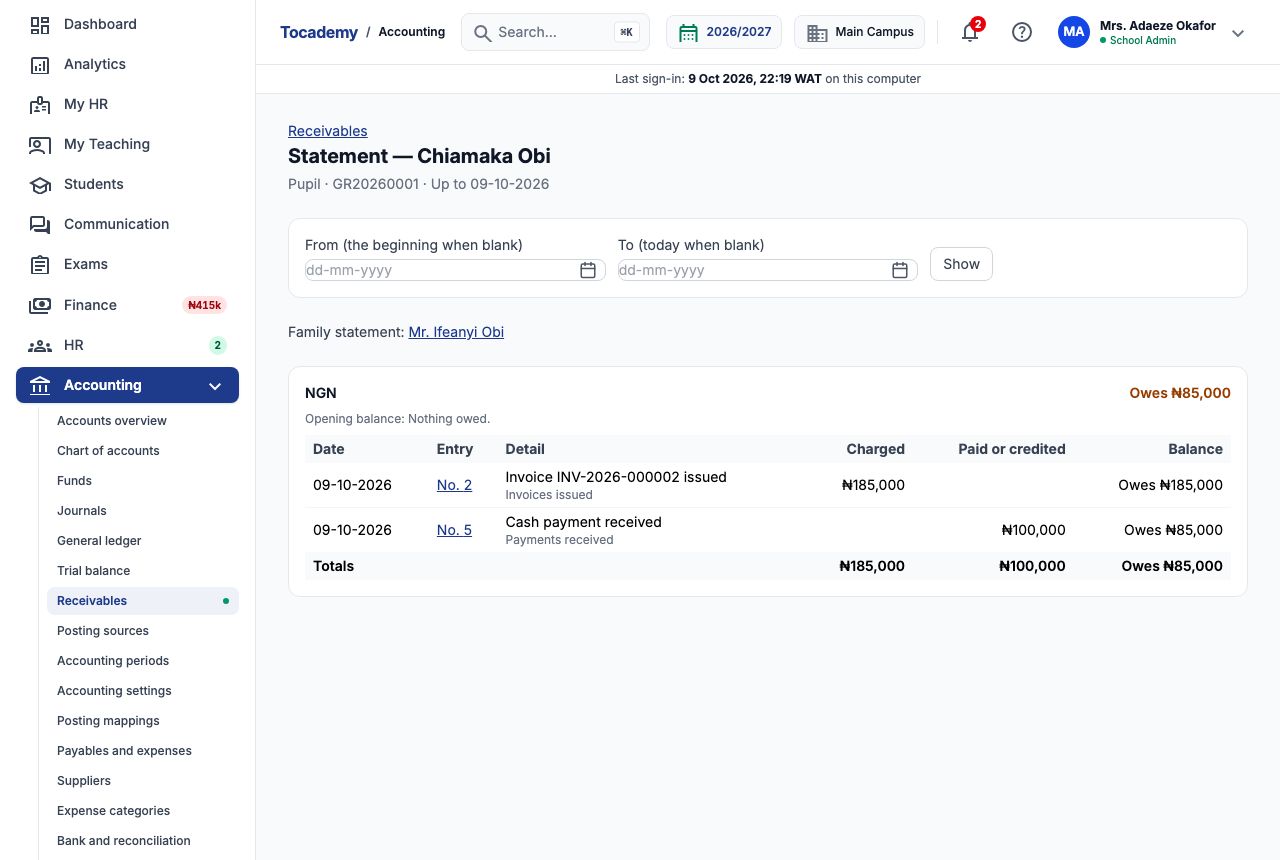
A statement lists every line for one child, oldest first. Each row shows the date, the entry number (which opens the full entry), the detail and the kind of transaction, what was charged, what was paid or credited, and the running balance. Chiamaka's reads: opening balance nothing owed; 09-10-2026, invoice INV-2026-000002 issued, charged ₦185,000, owes ₦185,000; 09-10-2026, cash payment received, paid ₦100,000, owes ₦85,000. Totals: ₦185,000 charged, ₦100,000 paid, owes ₦85,000. Set "From (the beginning when blank)" and "To (today when blank)" and press "Show" for one term only; the opening balance then carries in whatever was owed before. Above the table, a family statement link names each guardian linked to the child.
10. Example: the Obi family's statement
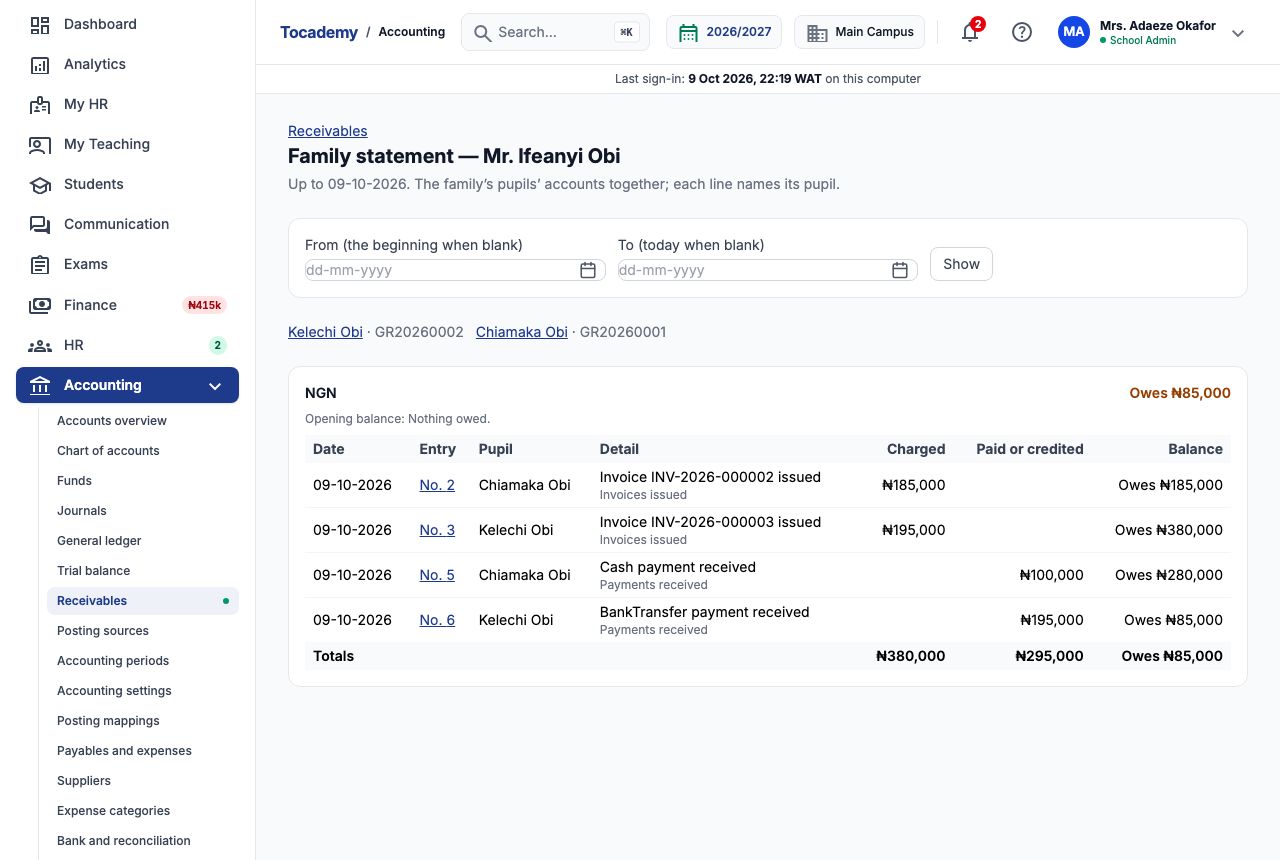
Click Mr. Ifeanyi Obi on either child's statement to open the family statement: every child linked to him, in one list, each line naming its pupil. The Obis read in order. Chiamaka is charged ₦185,000, so the family owes ₦185,000. Kelechi (JSS2 A, ₦160,000 tuition plus the same levy and books) is charged ₦195,000, so the family owes ₦380,000. Chiamaka's ₦100,000 cash brings it to ₦280,000. Kelechi's ₦195,000 bank transfer brings it to ₦85,000. Totals: ₦380,000 charged, ₦295,000 paid, owes ₦85,000. That ₦85,000 is entirely Chiamaka's, because Kelechi is paid up. This is the page to print or read out when a parent asks what the family owes across all their children. The children's names at the top link to their own statements.
11. Why a family statement follows the guardian
Finance bills each child separately, so the books keep each child's account separately too. A family statement simply puts together the accounts of every child linked to that guardian. It does not create a separate family account. A child linked to two guardians appears on both guardians' statements. For the family statement to be complete, each child must be linked to the same guardian record. When enrolling a second child, link them to the parent's existing guardian record rather than creating a new one with the same name, or the family will appear as two.
12. When Finance and the books disagree
Finance and Accounting should tell the same story: Greenfield's Finance menu shows ₦415k outstanding, and receivables reads ₦415,000. If Finance shows a bill that receivables does not, the bill has not posted yet. Look on Accounting → Posting sources for a failure under Invoices issued, fix the reason it gives and press "Retry". That is exactly what happened to Tobiloba's bill when an income account had been switched off; until it was retried, receivables read ₦230,000 while Finance read ₦415,000. If receivables shows a balance Finance does not, look for a manual journal to fees receivable. Fee corrections belong on the bill in Finance, not in a journal.
Who can see this
The receivables pages, statements and family statements need the "View the school's accounts" permission. By default the School Administrator, the Principal and the Bursar hold it. Family statements show amounts owed, so treat them like any other financial record when you print or share one.
Still stuck?
Email info@tocel.ng and tell us which guide you were following.